







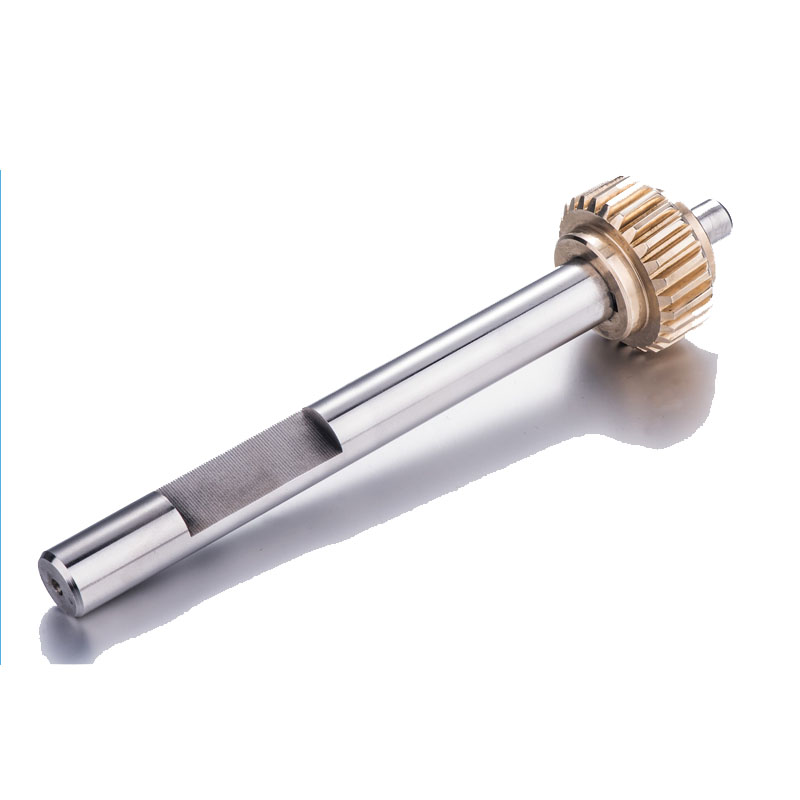
Precision Worm Wheel Centre Distance 17mm

Description

The gear variety designed as a duplex worm gear set is especially suited for drives that require positioning at precise angles with high gear ratios. A plus factor is that the gearing backlash can be adjusted repeatedly. If after a longer period of operation the circumferential backlash increases, the gearing can be readjusted so that it is low backlash. For this purpose, the worm shaft is shifted axially in the gear housing by small increments. This is done, for instance, using shim rings when installing the fixed bearing or by means of adjusting screws in the housing cover. The duplex gearing is distinguished by tooth flanks with different helix angles. Axial adjustment of the worm shaft results in low backlash engagement of the worm tooth pitch with the teeth of the worm gear.

Duplex gearing is used, for instance, in rotary and swivel tables that position components for processing or for automated assembly. In addition, low backlash worm gearing sets optimize optical and mechanical instruments in measurement and medical technology. Because the gearings are adjustable, instruments, components to be measured and optics can be precisely positioned throughout their entire service life.

Legende
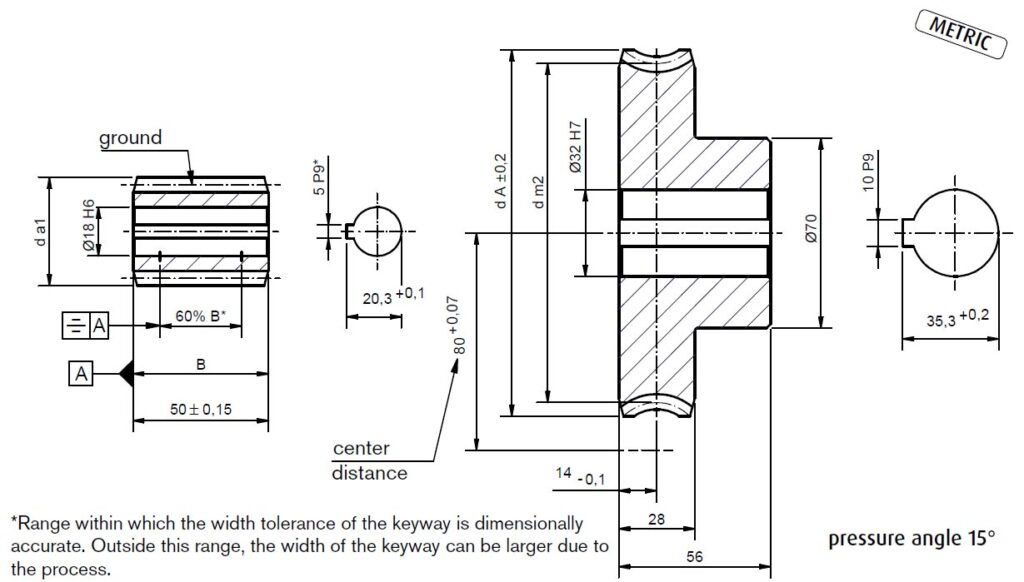
i = gear ratioda1 = tip diameter (worm)T2 = output torque
γm = Lead anglez2 = No. of teeth (worm gear)MF = mineral grease
mn = moduledm2 = pitch diameter (worm gear)MÖ = mineral oil / synthetic grease
z1 = number of threads (worm)dA = max. diameter (worm gear)SÖ = synthetic oil
dm1 = pitch diameter (worm)
Axial distance 80 mmiLead anglemWormWorm gearT2 [Nm]
 ShopBronze
 CAD-Dataz1dm1da1z2dm2dAMF
A80Ü76,75:123°35′44404827120132150180225
A80Ü1212:116°36′2,54354048125132,5243290365
A80Ü2020:18°58′3238,544,540121,5130,5290348435
A80Ü3030:15°44′41404830120132,5348417522
A80Ü5050:14°6′2,51354050125132,5248297372
A80Ü8080:12°9′1,51404380120124,5213255320

All worms and worm gears stocked right hand only.
Worm made of case hardened and ground steel (HV 620 – 700). Lead content is ≤0.1 percent by weight.
Worm gear made of CuZn37Mn3Al2Si. Lead content is ≤0.1 percent by weight.
Phenolic worm gears do not have the pre-drilled start for a pin. The outside diameter of the phenolic gear hub is 18 mm.
On request worm gears can be made of plastic or HGW 2083.

The output torque rating (T2) applies to the initial speed of 2800 rpm at the worm (shaft).
The efficiency values (see table in worm gear set catalog) are guidelines. The bearing, lubrication, speed, and installation, in addition to the lead angle, can influence efficiency.

Gears may be combined only with worms of the same axial distance and with the same transmission ratio.
Worms or worm gears from other manufacturers may not be paired with the counterpiece from Framo Morat. It is almost always necessary to adjust the toothing specifications.
All dimensions can be adapted upon request.

Is your desired gear set not available? Request your gear set!
Moderate quantities are usually available from stock, larger quantities are delivered in partial quantities or upon request.

Materials

The worms are made of case hardened steel with ground bore and worm profile. The worm gears are made of a special alloy (copper-zinc alloy with additives of aluminum, silicon and manganese). It is treated for better sliding characteristics. The chemical resistance is very high due to aluminum additives.

Brass worm gears

The worm wheels are made of a special alloy (copper-zinc alloy) with additives of aluminum, silicon and manganese. It is a special quality developed for sliding purposes.
The chemical resistance is very high due to the aluminum content.
Worm gears made of brass have good corrosion resistance, high strength, good sliding properties and high wear resistance.

Note:

The lead content in worms and worm wheels made of brass is ≤0.1 percent by weight

Plastic worm gears

Plastic worm gears are suitable for low sliding speeds (< 1.5 m/s) and medium tooth pressure due to their bad thermal conductivity. Worms have to be hardened and ground.
The thermal expansion coefficient is appr. 4 times higher than with brass. Therefore the backlash shouldn’t be too small.

Bronze worm gears

Cu Sn 12 DIN EN 1982
Comparatively soft material with good wear resistance, suitable for high sliding speeds.

Cu Sn 12 Ni DIN EN 1982
Comparatively soft material with very good wear resistance, suitable for very high sliding speeds.

CuAl10Fe5Ni5 DIN EN 1982
Comparatively hard material for high torque and low speed.

Cast iron worm wheels

EN-GJS-400-15 DIN EN 1563 / EN-GJL-250 DIN EN 1561
Only suitable for low planing speeds.

Self-locking

Self-locking is affected by the lead angle, the roughness of the flanks, the sliding speed, the lubricant and increases in temperature. Self-locking can be dynamic or static.

Dynamic self-locking: lead angle up to 3° with grease lubricant; lead angle up to 2.5° with synthetic oil lubricants.
Static self-locking: lead angle from 3° to 5° with grease lubricant; lead angle from 2.5° to 4.5° with synthetic oil lubricants.
No self-locking facility is available for lead angles over 4.5° or 5°.

Jarring and vibration can prevent gears from self-locking. Self-locking can also be adversely affected if sliding conditions are particularly good. This can be caused by a number of factors relating to the lubricant, sliding speed and loading. For this reason we are unable to assume any warranty obligations for self-locking.

Installing the worm gear

The reference surface tolerances will determine the lateral positioning of the worm gears. The lateral tolerance “c” must not exceed 0.15 mm for any centre distance.

You can tell if the worm gear is in the correct axial position by checking the position of the tooth contact pattern when the gear wheel is installed. If possible the tooth contact pattern should be towards the run-out side. When the gear is turned in the other direction (reverse operation) the tooth contact pattern should be towards the centre.

Efficiency

The efficiency of the worm gear set generally depends on the following parameters:

  • Lead angle of the worm
  • Sliding speed
  • Lubricant
  • Surface quality
  • Installation conditions

The larger the centre distance, the greater the degree of efficiency. Sliding bearings are often used with gears with smaller centre distances to save space and reduce costs. The sliding bearings have higher coefficients of friction, which can have a considerable effect on the overall efficiency of the gear. Efficiency data can be obtained from the manufacturer or our catalogue.

Helical gearing

The information on this website was generated with the greatest possible care and checked for accuracy. No liability will be accepted for any inaccurate or incomplete data.

Related Products

  • Precision Worm Wheel Centre Distance 18mm

    The gear variety designed as a duplex worm gear set is especially suited for drives that require positioning at precise angles with high gear ratios.

    View More
  • Precision Worm Wheel Centre Distance 17mm

    The gear variety designed as a duplex worm gear set is especially suited for drives that require positioning at precise angles with high gear ratios.

    View More
  • Bevel gear made of brass Ms58 module 0.5 15 teeth i=1:1 milled PN: 35020600

    The gear variety designed as a duplex worm gear set is especially suited for drives that require positioning at precise angles with high gear ratios.

    View More
  • Product 004

    View More